
Follow the Money
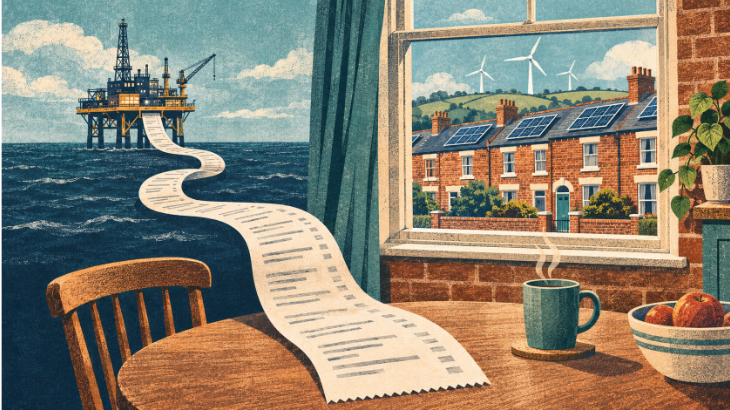
Why "Business as Usual" Is Britain’s Most Expensive Option
Whenever the pace of Britain’s net zero transition is debated – in Westminster, on the radio, or here in West Northamptonshire – the same question comes up: “Can we really afford to move away from oil and gas?”
It’s worth asking why that question is so common. Newspaper columns, phone-ins, TV panels and social media campaigns are regularly shaped by fossil-fuel-linked lobby groups, think tanks that don’t reveal their funders, and industry associations. Their cleverest tactic isn’t denying climate change. It’s treating “business as usual” as if it were free, while every pound spent on clean energy, insulation or electric transport is painted as a burden.
But add up what staying tied to fossil fuels actually costs, and the picture flips. Doing nothing, or slowing down, is already costing British households, businesses and taxpayers tens of billions of pounds.
1. “Business as usual” has a price tag
Relying on volatile global oil and gas markets keeps hitting Britain with expensive shocks. Here is what that looks like.
- £183 billion lost to gas dependency. Analysis by the Energy and Climate Intelligence Unit (ECIU) and E3G found that our reliance on fossil fuels after the 2022 energy crisis cost the country £183 billion over four years. That is more than NHS England’s entire annual budget (£177bn). It breaks down as £59 billion in extra household bills (roughly £6,400 per household once indirect costs are included), £65 billion in extra costs for businesses and public services, and £55 billion in taxpayer bailouts. Those bailouts alone still cost £2.4 billion a year in debt interest for the next 14 years1, 2.
- Every new global conflict hits our wallets. UK wholesale electricity prices are usually set by gas-fired power stations, so geopolitical shocks reach us almost immediately. When Middle East conflict pushed oil and gas prices up again in 2026, ECIU estimated that fossil fuel dependence added £190 million a week to energy bills and £183 million a week to road fuel costs1, 2.
- A £15–30 billion drain on trade, year after year. The UK has been a net importer of both oil and gas for two decades. In a typical year, buying foreign fossil fuels takes £15 billion to £30+ billion out of our national trade balance.
- The long-term bill for inaction. The Office for Budget Responsibility (OBR) says reaching net zero needs temporary public investment of roughly £116 billion – about 6% of GDP spread over 25 years, or less than £70 per person a year. By contrast, unchecked warming of 3°C would permanently shrink UK GDP by 8% by the 2070s and nearly double the impact on government borrowing. The Climate Change Committee (CCC) puts the net cost of the Seventh Carbon Budget at just 0.2% of GDP per year. Compare that with fossil fuel price shocks, which have triggered roughly half of all UK recessions since 19701, 2.
2. How the debate gets skewed
If staying tied to oil and gas is so expensive, why do calls to “pause” net zero dominate the headlines? Research by groups such as DeSmog6 and InfluenceMap6 shows how entrenched interests shape the conversation in three main ways.
- Counting the cost of change, but not the cost of staying put. Columns and pundits love to highlight the upfront price of heat pumps, grid upgrades or EVs. They rarely mention the £183 billion gas crisis bill, the £1.9 billion to £2.7 billion handed back to North Sea oil and gas firms in tax reliefs every year, or the £24 billion annual Fuel Duty hole the Treasury already faces as engines get more efficient.
- Think-tank and pundit pipelines. Regular guests and opinion writers often come from think tanks or trade bodies that don’t disclose their funders. Narrow vested interests get presented as the voice of “hard-pressed bill-payers”.
- Targeted social media framing. Paid campaigns and viral posts often blame green levies for high bills. In fact, wholesale fossil gas costs – and the VAT charged on them – made up roughly 75% of the extra household energy costs during recent crises1, 2, 3, 4.
3. Meanwhile, Britain’s green economy is outperforming fossil fuels
Look at what each sector actually contributes to the economy, and the contrast between managed decline and active growth is clear.
- Fossil fuels are a shrinking slice of the economy. According to Office for National Statistics (ONS) accounts, North Sea oil and gas extraction adds roughly £19 billion to £27 billion in Gross Value Added (GVA). That is under 1% of the UK total, down from 10.4% in 1982. Even with gas supply and refining included, direct fossil fuel sectors make up just 1.1%–1.5% of the economy. The OBR expects North Sea production tax receipts to fall to near zero by 2031–32.
- The green economy is already two to three times bigger. Using the ONS’s strict definition (the Environmental Goods and Services Sector), the core green economy generates £54.2 billion in GVA (2.2% of the UK economy) and supports 506,200 full-time equivalent jobs. Widen the lens to include supply chains such as EV engineering, grid upgrades and low-carbon construction, and CBI Economics and ECIU estimate £105 billion in GVA (3.8% of GDP) and 1.1 million jobs.
- Better pay, and money that stays local. CBI Economics found each full-time net zero job generates £119,300 in GVA (48% above the UK average) and pays £43,142 on average (11% above the national average). Over 96% of Britain’s 23,500+ net zero businesses are SMEs, and every £1 of direct output keeps £1.85 of supply-chain value circulating at home.
4. What this means for West Northamptonshire
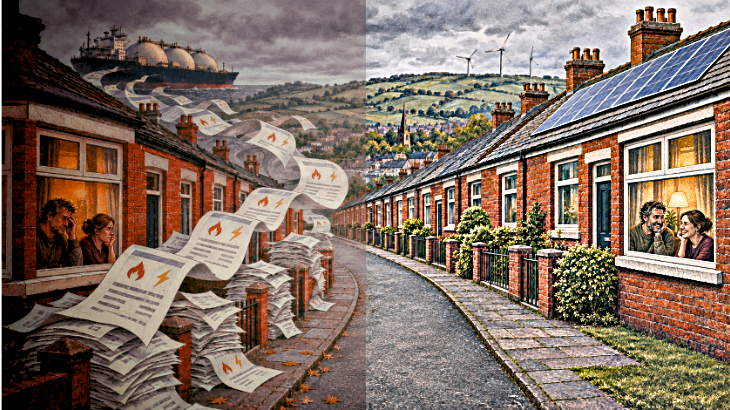
For an inland area rich in logistics and manufacturing, paying the “business-as-usual” tax is an economic dead end.
- Keeping our money here. Households across West Northants send tens of millions of pounds out of the county every year to pay for imported gas and petrol. Community energy, rooftop solar, home insulation and heat pumps keep that money circulating locally.
- Protecting local jobs. Across the East Midlands, nearly a quarter (23.9%) of workers are in higher-emission sectors such as logistics, manufacturing and distribution, compared with just 7.2% in London. Backing clean transport infrastructure, warehouse solar and local green skills means West Northamptonshire can win high-wage net zero investment instead of staying exposed to global fuel shocks.
The bottom line
When a columnist or talk-show guest warns that Britain can’t afford net zero, ask them to show you the receipt for “business as usual”.
Clinging to fossil fuels has already cost Britain £183 billion in a single crisis, drains tens of billions a year in energy imports, and leaves households at the mercy of global oil and gas spikes. Investing in warm homes, clean power and community energy here in West Northamptonshire isn’t an unaffordable luxury. It is how we stop paying the crippling price of inaction1, 2, 3.
REFERENCES
- Energy and Climate Intelligence Unit (ECIU) & E3G: Cost of the Fossil Fuel Crisis in the UK(2025/2026) — eciu.net | e3g.org
- Office for Budget Responsibility (OBR): Fiscal Risks and Sustainability Report — obr.uk
- Climate Change Committee (CCC): The Seventh Carbon Budget — theccc.org.uk
- Office for National Statistics (ONS): UK Environmental Accounts & Estimates of Green Jobs, UK — ons.gov.uk
- CBI Economics & ECIU: The Race for Net Zero: Economic Value and Job Creation Across the UK — eciu.net
- InfluenceMap & DeSmog: UK Climate Policy Lobbying & Media Monitoring — influencemap.org | desmog.com