
Electroefficiency: means more bang for your buck
If you follow climate news you may have noticed a new word doing the rounds this year: electroefficiency, sometimes written electro-efficiency. It was coined by Professor Jan Rosenow, an energy scientist at the University of Oxford, and behind the clunky name sits one of the most hopeful ideas in the whole energy transition: that switching to electric things doesn't just clean up our energy, it massively shrinks how much of it we need in the first place.
Most of us think of the move away from fossil fuels as a swap. Petrol car out, electric car in. Gas boiler out, heat pump in. The electricity that powers the new machines has to come from somewhere, so we build wind farms and solar parks to replace the oil and gas.
That picture is true as far as it goes, but it misses something important. Electric technologies don't just deliver the same services with cleaner energy; they deliver the same services with far LESS energy. Rosenow calls this combination of electrification and greater efficiency electroefficiency.
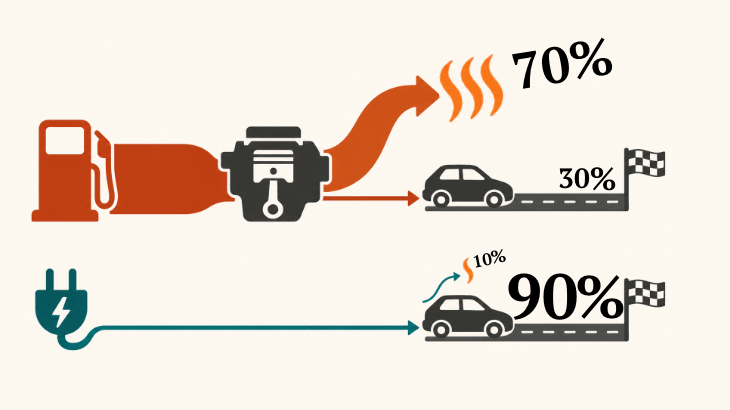
That headline diagram, based upon United States Environmental Protection Agency, Fuel Economy Website, Where the Energy Goes: Electric Cars shows that a petrol car and an electric car, travelling the same distance, make quite different use of their energy.
Why would an electric machine need less energy than its fossil-fuelled twin? It comes down to fire. When you burn something, whether it's petrol in an engine or gas in a boiler, most of the energy escapes as wasted heat before it ever does the job you wanted. An electric motor, by contrast, turns nearly all of its electricity into motion. The gap is striking: Professor Rosenow's research finds that electric technologies are typically three to five times more efficient than the fossil-fuel machines they replace, an advantage he describes as "the inbuilt efficiency of electric technology compared with fossil fuels".
The best example is the heat pump, which looks set to replace the gas boiler in millions of homes, including many here in West Northamptonshire. A boiler makes heat by burning gas. A heat pump doesn't make heat at all; it just moves it. Even on a cold day an air-source heat pump can harvest warmth from the outside air and concentrate it indoors, using electricity to do the moving rather than to create the warmth. The result is a device that delivers the same cosy rooms using around three-quarters less energy than a furnace. The humble LED bulb is an even simpler case, using about 90 per cent less energy than the old incandescent lights it replaced.
Multiply those savings across every car, boiler, factory and light in the world and the numbers become enormous. Rosenow estimates that a global switch to electrification could halve the world's total energy demand, freeing up trillions of pounds that would otherwise be spent on fuel, money that could flow instead to households, businesses and public services. For anyone who has winced at an energy bill in recent years, that is the real promise of electroefficiency: the cheapest unit of energy is the one you never have to generate, because an efficient machine didn't need it.
The idea has moved quickly from the lecture theatre to the world stage. At the UN climate talks in Bonn this June, electrification took centre stage for the first time, and despite COP31's disappointments it did produce The COP31 Global Climate Action Agenda Electrification Delivery Package1 intended to drive progress toward the COP31 Presidency's overarching goal of making electricity account for 35% of the world's final energy consumption by 2035 - 35x35. Some countries are already close: Japan has nearly reached that share, China is at about 30%, while the global average sits at just 21%.
None of this means electricity is magic. The grid needs upgrading to carry the extra load, heat pumps and electric cars still cost more upfront even when they save money over their lives, and some heavy industry and long-haul transport will need other solutions for years to come.
We don't have to replace it all, because once we electrify, we need far less than we thought
Electroefficiency changes the size of the challenge. The transition away from fossil fuels is often painted as a heroic feat of building enough clean generation to replace everything we burn today. Rosenow's insight is that we don't have to replace it all, because once we electrify, we need far less than we thought.
And it is an idea you can act on at home. Every heat pump installed, every LED bulb screwed in and every petrol car traded in for an electric one is electroefficiency in miniature: the same warm house, the same bright room, the same journey, done with a fraction of the energy. The climate solution, it turns out, isn't only about where our energy comes from. It's about needing less of it in the first place.
Reference 1
The COP31 Global Climate Action Agenda Electrification Delivery Package
You can watch Prof. Rosenow explaining electroefficiency on YouTube.