
Farming in crisis: Farming Policy 2026

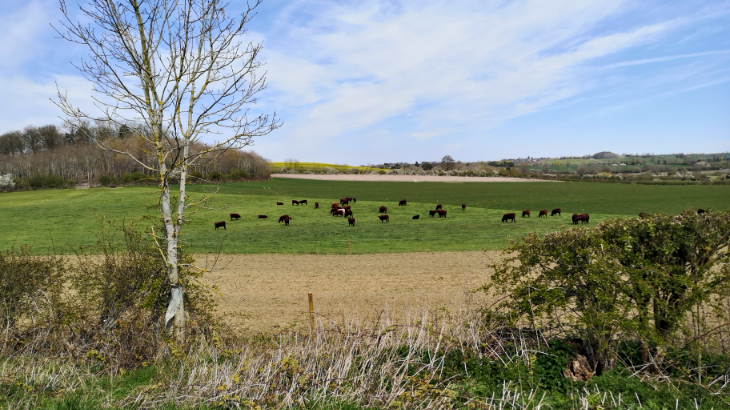
2025 was a dismal year for many farmers: the summer drought reduced yields for cereals and many other crops, the government cut off the Sustainable Farming Initiative (SFI) without warning, and budget changes to Inheritance Tax threatened many farm businesses. However the weather improved in the autumn. Doing my rounds in the county, I remarked on healthy crops and fields of green. Farmers that I met, agreed. Except for low-lying fields affected by flooding, crop prospects for 2026 look good. But since then, the prices paid to farmers for cereals have fallen and as they are based on world markets, there is little that can be done. Milk prices have also fallen due to a world glut and the only bright spot is livestock, beef and sheep, where the market is buoyant. The Iranian war will lead to increased costs all round.
I have been studying three recent reports:
- Farming Profitability Review 2025: an independent review by Baroness Minette Batters, former NFU president and current farmer.
- The 30-50-50 Mission. A report published in November 2025 by the All-Party Parliamentary Group on Science and Technology in Agriculture (APPGSTA) chaired by George Freeman MP
- Speech at the 2026 Oxford Farming Conference in January by Environment Secretary, Emma Reynolds.
These reports act as a wake-up call to the emasculation of English agriculture and the consequences for food security and food prices.
Definitions
First, a couple of definitions:
Food security: exists when all people, at all times, have physical and economic access to sufficient, safe and nutritious food to meet their dietary needs and food preferences for an active and healthy life.
Self-sufficiency: the ability of a region or country to produce enough food without needing to buy or import additional food.
Self-sufficiency
We are unlikely to achieve 100% self-sufficiency, even in items we produce ourselves. At the moment, we are about 62% self-sufficient. Britain was last truly self-sufficient in 1750, but by the Second World War it had slipped to about 40%. By the time of Margaret Thatcher it had recovered to its highest in modern times, nearly 80% in the 1980s. The more our self-sufficiency, the greater our food security.
Growing the Economy
Farmers produce the raw ingredients that underpin our food and drink sector, which is the largest manufacturing sector in the UK, worth £146 billion. Agriculture employs more than four hundred thousand people directly, but the wider agri-food sector supports over 4 million jobs. It is important to the political objective of growing the economy. But in the report conducted as part of the APPGSTA’s 30:50:50 programme the current situation points to a reduction in agriculture’s contribution. It suggests that the Government targets for housing, nature restoration, renewable energy, tree planting, and infrastructure development may result in the loss of up to 25% of currently farmed land over the next 25 years, including areas of high-quality arable land. Domestic food production in the UK could decline by up to 32% by 2050, or 39% per capita, if current trends continue and no changes are made to farming and land-use policies.
30:50:50
The report, Feeding Britain Sustainably to 2050, was launched at the Agri-Science Summit in Westminster on 3 November 2025. It outlines the Group’s proposed 30:50:50 mission: increasing agricultural output by 30% by 2050 while reducing the environmental footprint of farming by 50%. The Group recommends embedding this mission across all food, farming, and land-use policies. This does not mean adding 30% to 60% self-sufficiency to make 90%! Rather it proposes a statutory target of 75% domestic food self-sufficiency by 2050 taking into account population increase, some loss of agricultural land and yield improvements.
Where will the 30% increase in output come from? Does it mean more CO2 and methane and nitrous oxide? The public could play its part by eating less meat – see ‘How a Plant-Based Diet can help the Climate’ by Martin Coombs in CA-WN Exchange January 2026. But there are other opportunities to increase production while maintaining the structure of the countryside. Production can be increased without higher inputs. Back in 2013 it was revealed that wheat yields in trials were increasing by around 1.0 t/ha per decade, while on-farm yields had plateaued. At that meeting, farmers were castigated for neglecting their most important asset, their soil, and this has led to the adoption of ‘regenerative agriculture’.
Soil
Quoting AI and an article in Science Direct:
“Soil is an exceptionally important, large-scale carbon sink, storing roughly 1,500 to 2,500 billion tonnes of carbon—more than three times the amount in the atmosphere. As the second-largest active carbon store after oceans, it is critical for mitigating climate change, improving soil fertility, and fostering biodiversity”.
Note that it is ranked higher than trees, yet we know very little about it.
Amongst the 57 recommendations by Minette Batters was an emphasis on soil health, urging that soil health strategies should support, not hinder, food-producing crops. These strategies include:
- Crop rotation to include nitrogen-fixing deep rooting crops,
- Improving the structure of the top-soil by reduced tillage (less ploughing etc),
- Cover crops to prevent soil erosion, hold on to soluble nutrients and protect rivers from run-off,
- Research into soil structure, aeration, drainage, micro-organisms etc
The goal is to transition farming toward a model that delivers dual benefits: high-quality food production and significant environmental gains. One aspect is the "SOILSHOT" + Nature taskforce, an initiative to create standards for measuring environmental outcomes, such as carbon, soil health, water quality, and biodiversity.
Land Sharing vs Sparing
Two years ago, I wrote about sharing and sparing (CA-WN Exchange March 2024). There is no direct mention in Minette Batters’ report although it is hinted. Also it is not mentioned in the Speech at the 2026 Oxford Farming Conference in January by Environment Secretary, Emma Reynolds, nor in her more recent speech at the NFU national conference.
However, MPs in the APPGSTA report pointed to “strong evidence that the UK’s current ‘land-sharing’ farm policies will reduce or displace domestic food production, increasing our dependence on imports at a time of heightened geopolitical instability, and exporting the climate and biodiversity impacts of our food system”.
It is obvious that soil improvements are compatible with land sharing, but many other environmental activities are incompatible: for example, agro-forestry, organic farming, wild flowers (weeds!) and many pests and diseases.
Much of what Emma Reynolds is promising is to be applauded. But she is still reluctant to view farming as a serious industry. She quotes a visit to
“a small mixed farm with native breed sheep, rare breed pigs and an agroforestry approach that weaves trees and hedgerows into productive farmland…….. the hedgerow management gives their livestock shelter and supports wildlife, their grazing system improves soil health, environmental management and productive farming working together on the same land.”
It is a pretty picture shared by many townspeople, but it does not support the drive to 75% self-sufficiency.
Public money for public good
The original Environmental Land Management Scheme (ELMS) hardly mentioned farming, but aimed to transfer the EU farm support scheme to ‘public money for public good’. In many ways, farmers prefer this - making the bulk of their income from producing food (or timber, fibre, oil etc) for the market. Providing they do not pollute the environment, treat employees fairly and run their businesses as responsible citizens, the government and the public should be happy. If the public want more, especially in unproductive areas and field margins, the taxpayer should pay.
There has been a subtle change in terminology which farmers did not notice. We no longer have ‘environmental land management’: it has been replaced by the ‘Sustainable Farming’ Incentive (SFI). In other words, government (listening to many non-farming lobbies) has decided to incentivise how farmers should farm. The scheme has been a disaster, especially for many smaller farmers who were slow to apply. Some larger farmers realised there was money to be made from abandoning food production and planting wild flowers. The scheme had a finite budget and ran out of money leaving many smaller famers without the promised replacement for the EU grant.
The Land Use Framework for England
The now published Land Use Framework for England aims to balance competing demands on land, including food production, nature recovery, climate targets, and infrastructure.
The farming and food industry has woken up to the threats facing it. The government and the public have woken up to the importance of self-sufficiency in an unstable world. We must make sure that decision makers understand farming and forestry and decide with their heads, not their hearts.
It is important that we get the right balance between all the competing demands for land. The framework is a critical part of the government's strategy to reach environmental goals while maintaining food security.